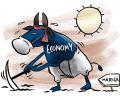
Almost 63 per cent of the increased allocation of around Rs 1.01 trillion has been spent in the first five months of 2020-21.

Fitch reaffirmed India's rating at 'BBB-' with a Stable Outlook saying the rating balances a still strong medium-term growth outlook compared with similar category peers and relative external resilience stemming from solid foreign-reserve buffers against high public debt, a weak financial sector and some lagging structural factors, including governance indicators and GDP per capita.

In April, the World Bank had projected India's GDP would grow at 6.1 per cent in the current financial year and at 6.7 per cent the following year.

'India's sizeable foreign exchange reserves should serve as a buffer.'

Non-banking finance companies face renewed asset quality and liquidity risks amid a second wave of COVID-19, Fitch Ratings said on Thursday. These challenges are likely to increase if recent restrictions to contain the pandemic are expanded or prolonged, leading to greater economic and operational disruption, it added. The rating agency further said that an increase in the rate of infections and broadening of social distancing restrictions pose downside risks to its 12.8 per cent growth projection for the current fiscal.
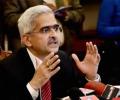
'No one cares about fiscal deficit now. Or for that matter, inflation.' 'The focus is on growth and growth alone.' 'RBI needs to break the risk aversion of banks and infuse adrenaline in their veins', says Tamal Bandyopadhyay.

The Indian economy is rapidly normalising towards pre-pandemic activity levels, even as uncertainty exists about coronavirus mutations and repeated infection waves, industrialist Kumar Mangalam Birla said on Wednesday. Vaccination is picking up pace, which would improve India's resilience against a potential third wave, the chairman of Aditya Birla Group said while virtually addressing shareholders at the AGM of group firm UltraTech Cement Ltd. Moreover, various steps taken by the RBI and the government have helped in containing the economic disruptions of the pandemic, Birla added.

'We can go somewhere between 35 per cent and 40 per cent.'
'When we look at the quality of our retail loan book, the non-performing asset percentage is low.'

The plan could mature into either an umbrella programme for urban youths similar to the Garib Kalyan Rozgaar Abhiyaan or a modified urban-focused version of MGNREGS.

'Hope they don't tinker around with capital gains tax in any way.'

The Indian financial system's asset quality improved despite the pandemic, but it could be due to special dispensations by the regulator, and banks would likely see increased stress on their books once the schemes expire. According to the annual trend and progress report of the Reserve Bank of India (RBI) released on Tuesday, the data available for this financial year so far indicate that banks' bad debts have moderated while provision coverage ratios (PCRs), capital buffers as well as profitability indicators have improved relative to pre-pandemic levels.

'Indices will remain range bound in 2022 as earnings catch up with the current multiples.'

As India emerges from the COVID-19 crisis, the ninth budget under the Modi government, including an interim one, is widely expected to focus on boosting spending on job creation and rural development, generous allocations for development schemes, putting more money in the hands of the average taxpayer and easing rules to attract foreign investments.

The Indian economy will suffer lasting damage from the coronavirus crisis and after an initial strong rebound in FY22 (fiscal year ending March 2022) growth will slow to around 6.5 per cent a year over FY23-FY26, Fitch Ratings said on Thursday. "A combination of supply-side scarring and demand-side constraints - such as the weak state of the financial sector - will keep the level of GDP well below its pre-pandemic path," it said in commentary on the Indian economy. Fitch said India's coronavirus-induced recession has been among the most severe in the world, amid a stringent lockdown and limited direct fiscal support.

He did not believe in any fiscal puritanism. In 2012, when it was almost certain that the government will breach the 2012-13 fiscal deficit target, he wrote that in abnormal times, abnormal measures are required to get back to normalcy.

But their trajectory and direction have been largely influenced by politics and the political leadership's understanding of how the economy needs to be managed, explains A K Bhattacharya.

Arun Jaitley had promised to provide more than the budgeted amount.

The report cautioned that low capacity utilisation and stressed balance sheets of banks and businesses will prevent a strong investment revival in the short term.

Stating that COVID-19 has not yet been contained in India, the rating agency in a statement said the government stimulus package is low relative to countries with similar economic impacts from the pandemic. "The COVID-19 outbreak in India and two months of lockdown -- longer in some areas -- have led to a sudden stop in the economy. That means growth will contract sharply this fiscal year (April 2020 to March 2021)," it said. "Economic activity will face ongoing disruption over the next year as the country transitions to a post-COVID-19 world."

'We have already sanctioned loans worth over Rs 3,000 crore to around 120,000 customers.'
Amid prolonged uncertainty, continued policy support will be crucial for sustained economic recovery from the coronavirus pandemic, Reserve Bank Governor Shaktikanta Das said at the recent meeting of the Monetary Policy Committee. "In this period of prolonged uncertainty, it would be wise to remain agile and respond in a gradual, calibrated and well telegraphed manner to the emerging challenges," opined Das, according to the minutes of the MPC meeting released by the Reserve Bank on Thursday. Observing that economic recovery from the pandemic remains incomplete and uneven, he said, "continued support from various policies remains crucial for a sustained recovery." The governor said the renewed surge in international crude oil prices, however, requires close monitoring.

Public sector banks (PSBs) have written off a massive Rs 8 trillion of loans in the seven years of the Narendra Modi government in office. This is more than twice the capital infused by the Bharatiya Janata Party-led government during the period. Between 2014-15 and 2020-21 (FY21), the Centre had infused Rs 3.37 trillion into PSBs. At Rs 1.06 trillion, FY19 saw the highest capital infusion.

After several years of downgrades to the country's medium-term growth outlook, the estimates are likely to be upgraded now, Credit Suisse said in a report. The country's economy is showing signs of bottoming out, it said. According to the report, the consensus forecasts of GDP growth for FY2022 over FY2020 stopped falling after October 2020 (currently at (-) 1 per cent). Analysts at Credit Suisse expect these estimates to be revised upwards.

"Lot of misinformed speculation is going around in media. Government's fiscal math is completely on track. There is no proposal to ask RBI to transfer Rs 3.6 or 1 lakh crore, as speculated," Economic Affairs Secretary Subhash Chandra Garg tweeted.
.jpg)
Declining prices of food items like vegetables pulled down retail inflation to 5.59 per cent in July, bringing it back within the RBI's comfort zone after two months, official data showed on Thursday. The retail inflation based on the Consumer Price Index (CPI) had remained above 6 per cent during May and June. The government has mandated the RBI to maintain retail inflation at 4 per cent, with a margin of 2 per cent on either side. The CPI based inflation stood at 6.26 per cent in June 2021 and 6.73 per cent in July 2020.

Subdued prices of food items like vegetables pulled down retail inflation for the third month in a row to 5.3 per cent in August, within the RBI's comfort zone. While the Consumer Price Index (CPI)-based retail inflation declined to 5.3 per cent in August from 6.69 per cent in the same month a year ago, food inflation dipped at a much faster pace to 3.11 per cent from 9.05 per cent in August 2020. The food inflation was also lower than 3.96 per cent in preceding month of July.

Is the worst over for Indian banks? The past two years saw them ride on treasury trades as deposits soared and credit growth dipped sharply. Gross and net non-performing assets (NPAs) moved south, and the provision coverage ratio (PCR), capital buffers, and profitability indicators are back at pre-pandemic levels. So, what's the plot ahead?

NSO Group, an Israeli surveillance software company, has been under increasing attack following allegations that its Pegasus phone spyware was used for surveillance on journalists, activists and political leaders in several countries including India. NSO has denied any wrongdoing.

'If you do quick back-of-the-envelope calculation, someone earning Rs 10 lakh can get a benefit of anywhere between Rs 35,000 and Rs 45,000, even if s/he is availing exemptions.' 'A large proportion of people do not avail full exemptions as they don't have money to invest in those schemes.'

'Once the lockdown is lifted, we will need the mother of all fiscal and monetary policy support to sustain the economy,' advises Akash Prakash.

Homegrown auto major Mahindra & Mahindra on Tuesday said it plans to launch 16 electric vehicles (EVs) by 2027 across SUV and light commercial vehicle categories to strengthen its leadership position in India's electric mobility segment. The company, which has set a cumulative revenue growth target of 15-20 per cent by 2025, is keeping its options open to either bring in private equity investors or carve out its EV business into a separate entity to drive its growth. M&M, which has already announced plans to invest Rs 3,000 crore in EVs, is also considering a new brand name for the electric SUVs that it will launch by 2027.
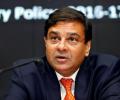
The RBI projection of 6.9 per cent GVA growth for the current fiscal comes on the back of the Economic Survey last week forecasting economic growth of 6.5 per cent.

Revenue grew 5.1 per cent in the quarter under review to Rs 39,946 crore from Rs 38,010 crore in the corresponding period last fiscal.
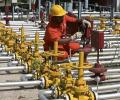
The oil ministry has stopped making fresh allocation of natural gas from domestic fields to the city gas sector, threatening the viability of Rs 2 lakh crore investment planned in the sector besides leading to a hike in CNG and piped cooking gas prices to record levels, sources said. Despite a decision of the Union Cabinet to give 100 per cent gas supply under 'no cut' priority to the city gas distribution (CGD) sector, current supplies have been maintained at March 2021 demand level. Besides, the process of allocating gas on a six-monthly average drawl also is punishing the CGD entities driving growth.

To attract potential suitors, the government will ease asset valuation norms for Air India by allowing bidders to put in offers on an enterprise value basis, a source said on Monday. To begin with, the government is likely to further extend the deadline for putting in a preliminary expression of interest for the loss-making national carrier to December 15. The source said bids will be sought on an enterprise value basis - a popular valuation methodology for takeover deals.

Stating that a weak fiscal position continues to constrain India's sovereign ratings, Fitch said the next government's medium-term fiscal policy will be of particular importance from a rating perspective.

While the market may remain volatile this year, analysts expect equities to deliver positive returns by outperforming inflation and government bonds, supported by the fiscal stimulus in the US.

'Event management can distract from, but not permanently mask, execution failures,' points out Rathin Roy, director, National Institute of Public Finance and Policy.

Fitch had last upgraded India's sovereign rating from BB+ to BBB- with a stable outlook on August 1, 2006.
